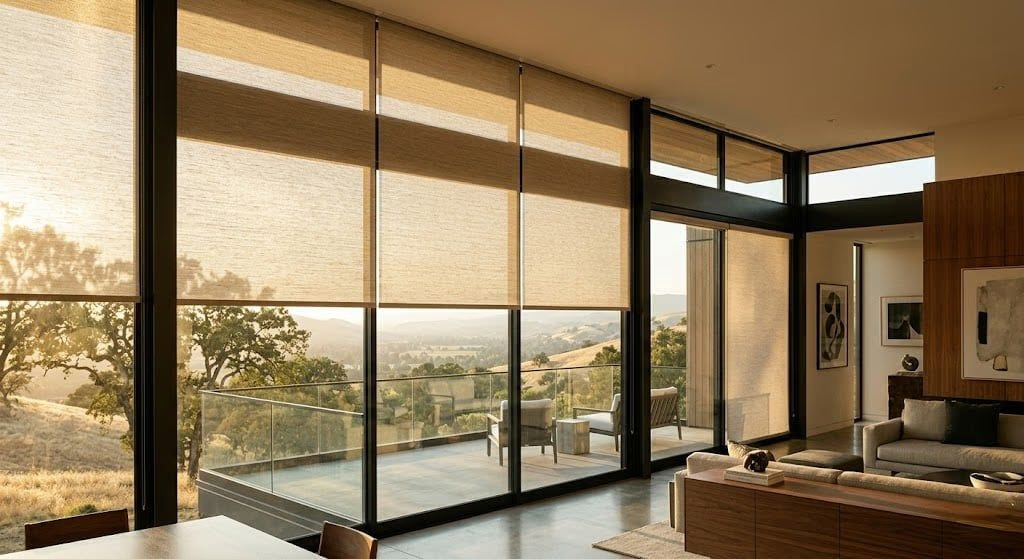
Healdsburg Mill District - Olson Kundig Architectural Window Treatments
Olson Kundig's Mill District residences demand window treatment systems that disappear completely when retracted and operate in near-silence. Discount Best Blinds and Shutters specifies recessed ceiling-pocket mounting with sub-35 dBA premium motorization for every Olson Kundig project in Healdsburg 95448, preserving the uninterrupted glass planes and raw material palettes that define Design Principal Kirsten Ring Murray's Sonoma County work.
The Mill District's contemporary luxury homes feature floor-to-ceiling glass walls that dissolve the boundary between interior living and the Sonoma County landscape. These architectural glass expanses - often 10 to 14 feet tall with NanaWall sliding systems spanning 28 feet or more - require shade systems engineered at an architectural level. Standard off-the-shelf treatments cannot address the scale, the noise sensitivity of open floor plans, or the design rigor of an Olson Kundig commission. Discount Best Blinds and Shutters brings the specification-grade expertise these projects demand: coordinating with architects during design development, routing low-voltage power during rough-in, and installing recessed systems that maintain the architect's sightlines from first occupancy.
Why Olson Kundig Homes Require Purpose-Built Shade Systems
Olson Kundig's design philosophy centers on raw materiality - exposed steel, board-formed concrete, and Western red cedar - framed by expansive glass that connects interior volumes to the surrounding landscape. In Healdsburg's Mill District, this translates to homes where glass walls are the primary architectural feature. Any window treatment that introduces visible hardware, bulky valances, or surface-mounted tracks contradicts the design language. The shade system must perform at the level of the architecture: spanning enormous openings, vanishing completely when not in use, and operating with mechanical precision that matches the home's build quality.
The thermal and UV challenges are equally demanding. West-facing glass walls in the Mill District receive intense afternoon sun from May through October, driving interior temperatures that strain even high-capacity HVAC systems. UV exposure at 99% transmission through unshaded glass degrades Western red cedar finishes, fades art collections, and deteriorates hardwood flooring within months. The window treatment must deliver both UV rejection and solar heat gain control without compromising the transparency that defines the home.
Recessed Headrail Pocket Engineering
The recessed ceiling pocket is the defining technical requirement for Olson Kundig installations. A pocket measuring 4.5 to 6.0 inches deep is built into the ceiling framing above each glass opening, creating a concealed cavity that houses the shade roller, Palladiom motor, and mounting hardware. When the shade is retracted, the entire assembly rolls into the pocket and disappears behind a flush drywall edge. There is no visible fascia, bracket, or track - the glass wall appears exactly as the architect intended.
Pocket construction requires coordination during the framing stage. Discount Best Blinds and Shutters provides detailed pocket specifications to the general contractor including cavity depth, width, and structural blocking requirements for large-span shades. Low-voltage power conduit for hardwired Palladiom motors is routed during rough-in alongside electrical and HVAC runs. For Olson Kundig projects coordinated through Kirsten Ring Murray's studio, we deliver pocket schedules that align with the architectural drawing set, ensuring every opening receives the correct pocket dimension for the specified shade type and fabric weight.
Fabric Selections That Honor the Material Palette
Olson Kundig interiors privilege raw, honest materials - concrete, steel, glass, and timber. The shade fabric must complement this palette without introducing synthetic textures or artificial sheen. Hartmann and Forbes hand-woven natural fiber shades in bamboo, jute, and abacá provide organic texture that resonates with Western red cedar millwork. For solar performance requirements, Conrad Original architectural roller fabrics deliver 99% UV blocking at 1% openness with a refined flat weave that reads as a neutral plane rather than a decorative element. Both lines are specified by architects and interior designers for projects where the fabric must perform technically without competing visually with the material palette.
Olson Kundig Mill District Specification Summary
| Feature | Value | Notes |
|---|---|---|
| Motor System | Lutron Palladiom | Sub-35 dBA - whisper-quiet for open floor plans |
| Max Shade Span | Up to 192″ | Single-track coverage for NanaWall systems |
| Mounting Method | Recessed ceiling pocket | Invisible when retracted - zero visible hardware |
| Pocket Depth | 4.5″–6.0″ typical | Coordinated during framing stage |
| UV Protection | 99% (1% openness solar) | Protects Western red cedar and art collections |
| Integration | Lutron RadioRA 3 · Savant · HomeKit | Unified whole-home control |
| Fabric Options | Hartmann and Forbes · Conrad Original | Architect-specified natural and solar fabrics |
| Power | Hardwired (low-voltage) | Routed during rough-in for permanent reliability |
Olson Kundig and Mill District Window Treatment Questions
What are recessed headrail pockets and why do Olson Kundig homes require them?
Recessed headrail pockets are concealed ceiling cavities built during framing that house the shade roller, motor, and mounting hardware. When the shade is retracted, it disappears entirely into the ceiling with no visible fascia, track, or bracket. Olson Kundig designs are defined by uninterrupted glass planes and minimal material transitions, meaning any visible window treatment hardware contradicts the design intent. Recessed pockets preserve the architect’s clean sightlines while delivering full motorized light control, UV protection, and thermal management on demand. Discount Best Blinds and Shutters coordinates pocket dimensions directly with the general contractor during the framing stage to ensure a seamless result.
How quiet is the Lutron Palladiom motor system in an open-plan Mill District home?
The Lutron Palladiom operates at sub-35 dBA, roughly equivalent to a whisper or a quiet library. In open-plan Mill District homes where the living area, kitchen, and entertaining spaces share a single volume, motor noise from window treatments would be immediately noticeable. Palladiom motors are specifically engineered for large-format architectural installations, driving shades up to 192 inches wide without gear noise or vibration. They are hardwired for continuous power, eliminating battery replacement cycles across dozens of motorized zones. Discount Best Blinds and Shutters specifies Palladiom for every Mill District project regardless of shade type.
Can Hartmann and Forbes natural fiber shades span oversized Olson Kundig glass walls?
Hartmann and Forbes hand-woven natural fiber shades can be fabricated in widths compatible with Olson Kundig’s oversized glass wall specifications when paired with appropriate motorized headrail systems. For openings exceeding standard fabrication widths, Discount Best Blinds and Shutters specifies coupled shade assemblies on continuous Lutron Palladiom tracks that maintain seamless alignment across the full opening. The natural fiber materials - including bamboo, jute, and abacá - complement the raw material palettes (concrete, steel, Western red cedar) that define Olson Kundig’s Sonoma County residences.
When in the construction timeline should window treatments be planned for a new Mill District home?
Window treatment planning should begin during the design development phase, before framing. Recessed ceiling pockets require structural coordination with the framing plan. Low-voltage power routing for hardwired Palladiom motors must be specified during rough-in alongside electrical and HVAC runs. Blocking for large-span shade assemblies needs to be installed before drywall. Discount Best Blinds and Shutters works directly with Olson Kundig project architects and the general contractor to deliver pocket specifications, motor schedules, and fabric selections that align with the construction timeline. Late-stage planning results in costly retrofits or surface-mount compromises.
Explore More Solutions
Architectural Glass Solutions
Floor-to-ceiling motorized systems with invisible recessed mounting.
Mill District Service Area
Dedicated window treatment services for Healdsburg's Mill District.
Hartmann and Forbes
Hand-woven natural fiber shades specified for architectural projects.
Smart Home Automation
Lutron RadioRA 3 and Savant integration for whole-home control.
UV Protection
99% UV blocking to protect Western red cedar and art collections.
Trade Professionals
Architect and builder coordination for specification-grade projects.
Planning an Olson Kundig or Mill District Project?
Phil D. Skikos coordinates directly with Olson Kundig project architects, general contractors, and interior designers to deliver recessed pocket specifications, motor schedules, and fabric selections that align with the construction timeline. Contact us during design development for the best results.